Key Points:
- Mass Tractor Demonstration in Capital: Around 500 tractors from major agricultural organizations ASAJA, COAG, and Unión de Uniones descended on central Madrid across five converging columns to protest soaring production costs and unfair competition.
- Protest March Suspended Following Rail Disaster: The planned march toward the Ministry of Agriculture was called off on the spot after news broke of a deadly high-speed train collision in Urda, Toledo province.
- Five Minutes of Silence at Plaza de Colón: Farmers gathered at Plaza de Colón and near Calle de Serrano to observe five minutes of solemn silence in memory of the rail crash victims before dispersing.
- Core Agricultural Demands Retained: Unions reaffirmed their core grievances, including demands for professional tax-free farm diesel, fair market pricing, reduction of bureaucratic red tape, and protection against non-EU trade agreements like Mercosur.
- New Protests to be Scheduled: Agricultural leaders announced that executive committees will meet to establish a new national calendar of mobilizations and tractor rallies in the coming days.
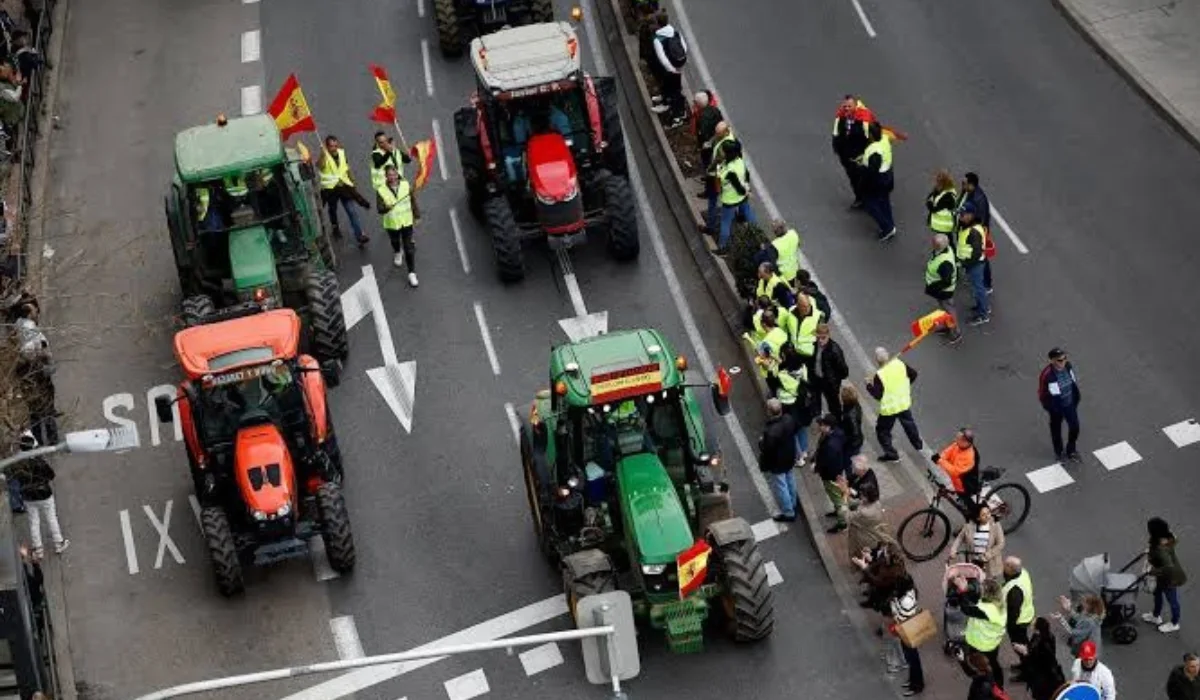
Madrid (Madrid Journals) October 31, 2026 – Hundreds of green agricultural tractors rumbled into central Madrid on Wednesday, 28 October 2026, as Spanish farmers launched a major protest against escalating operational costs, diminishing profit margins, and uncompetitive international trade deals. Organized by the country’s prominent agricultural unions—ASAJA, COAG, and Unión de Uniones—an estimated 500 tractors entered the capital in five distinct columns, surrounding iconic thoroughfares including Calle de Serrano and Plaza de Colón. However, in a dramatic shift, union leaders canceled their scheduled march to the Ministry of Agriculture upon receiving confirmation of a catastrophic high-speed train collision in Urda, Toledo province. Instead of continuing their planned rally, hundreds of farmers stood alongside their parked machinery in high-visibility vests to observe five minutes of silence for the rail disaster victims before agreeing to reschedule their national protest calendar.
- Key Points:
- How did hundreds of tractors enter central Madrid during the October 28 protest?
- Why did Spanish farming unions suspend their march to the Ministry of Agriculture?
- What are the key demands being raised by ASAJA, COAG, and Unión de Uniones?
- When will the next calendar of agricultural protests be announced?
- Background of Spain’s Agrarian Crisis and Production Cost Inflation
- Agricultural Policies, Food Prices, and Future Demonstrations
How did hundreds of tractors enter central Madrid during the October 28 protest?
As reported by agricultural correspondents for Demócrata, the coordinated mobilization saw five separate tractor columns converge on Madrid from peripheral staging points early Wednesday morning. The columns advanced into the urban core from Torrejón de la Calzada, Guadalajara, El Espinar, Buitrago del Lozoya, and Arganda del Rey, bringing heavy agricultural machinery into financial and commercial districts.
Eyewitness accounts and video footage filmed near Calle de Serrano and Plaza de Colón captured dozens of green and yellow tractors lined up along wide avenues beneath high-rise towers. Demonstrators wearing reflective safety vests parked their vehicles along major boulevards, creating a striking visual contrast against the city’s commercial architecture.
As reported by Demócrata, local resident and eyewitness observer Giaccomoleopard remarked via social media: “It felt so strange to see this on Serrano and Colón,” describing the unusual presence of agricultural machinery traversing upscale residential and shopping districts.
Why did Spanish farming unions suspend their march to the Ministry of Agriculture?
As reported by El Conciso and Spanish news agencies, the planned march from Plaza de Colón to the headquarters of the Ministry of Agriculture was abruptly canceled following news of a major railway accident in the province of Toledo.
A high-speed Renfe passenger train collided with a stationary Iryo train near Urda on Wednesday morning, resulting in heavy casualties and prompting the Spanish government to declare three days of national mourning.
Upon confirming the magnitude of the tragedy, executive directors from ASAJA, COAG, and Unión de Uniones made the joint decision to halt all confrontational public activities. As reported by Moncloa, the farming organizations opted to replace the political demonstration with a collective five-minute period of silence at Plaza de Colón out of respect for the victims, their families, and emergency rescue personnel working at the crash site in Toledo.
What are the key demands being raised by ASAJA, COAG, and Unión de Uniones?
As reported by trade journalists for Demócrata, despite suspending the street march, the three main agricultural unions maintained their joint rejection of current government policies and reiterated five core sector demands:
- Professional Farm Diesel: Immediate implementation of subsidized, tax-exempt agricultural diesel to offset soaring fuel and fertilizer costs.
- Fair Pricing & Market Protection: Enforcing fair purchasing prices at the origin to guarantee economic viability for farms and ending unfair competition from non-EU imports under proposed trade pacts such as the Mercosur agreement.
- Reduction of Administrative Red Tape: Slashing complex administrative obligations, digital registry requirements, and bureaucratic procedures under the Common Agricultural Policy (CAP).
- CAP Budget Protections: Rejecting proposed funding cuts to European agricultural subsidies and demanding direct financial support for livestock and crop farming.
- Preference for EU Production: Re-establishing strict community preference standards to protect domestic producers against lower-cost, non-EU agricultural goods entering the European single market.
As reported by Demócrata, union representatives warned that Spanish farmers are “tired of competing under unequal conditions,” criticizing regulatory frameworks that impose strict environmental standards on domestic growers while permitting freer entry for non-EU imports.
When will the next calendar of agricultural protests be announced?
As reported by rural affairs reporters for El Conciso, executive leadership teams from ASAJA, COAG, and Unión de Uniones are scheduled to convene in the coming days to draft a revised mobilization roadmap.
Organizers confirmed that while the Madrid tractor rally was paused out of solidarity with the Urda rail crash victims, the underlying economic grievances of the agricultural sector remain entirely unresolved. Union spokespersons stated that the newly agreed-upon protest dates and location targets across autonomous communities will be announced publicly once formal coordination between regional delegations is complete.
Background of Spain’s Agrarian Crisis and Production Cost Inflation
Spain’s agricultural sector has faced compounding financial pressure over the past three years, driven by a combination of persistent drought conditions across southern and central regions, elevated energy costs, and strict European environmental compliance mandates under the EU’s Green Deal framework. The rising cost of diesel, electricity, seeds, and fertilizers has severely eroded farm profitability, pushing smaller family-run operations toward financial insolvency.
Throughout 2024 and 2025, Spanish farmers repeatedly blocked major highways and border crossings to protest low supermarket purchasing prices and the implementation of the electronic farm logbook (cuaderno digital). Tensions escalated further in 2026 amid ongoing negotiations surrounding the EU-Mercosur trade agreement, which Spanish farming lobbies argue will flood domestic markets with beef, poultry, and produce that do not adhere to European phytosanitary and environmental regulations. The planned October 28 tractor rally in Madrid was designed as the largest national demonstration of the year, bringing together regional delegations from across the Iberian Peninsula to force direct policy concessions from the Ministry of Agriculture.
Agricultural Policies, Food Prices, and Future Demonstrations
The suspension of the October 28 Madrid protest and the upcoming announcement of a revised mobilization calendar are predicted to maintain significant political pressure on both regional authorities and the national government.
For Spanish consumers and food retail networks, prolonged agricultural protests and prospective highway blockades in late 2026 will likely disrupt domestic supply chains for fresh produce, dairy, and meat products. If upcoming union mobilizations involve widespread road blockades along major transport arteries surrounding Madrid, distribution centers may experience localized shipping delays, potentially placing upward pressure on retail food prices through the winter months.
For the Ministry of Agriculture and European policy makers, the unified front maintained by ASAJA, COAG, and Unión de Uniones indicates that minor concessions will not satisfy the sector. Analysts predict that unless the government delivers concrete relief on professional fuel taxation and introduces stricter import checks on non-EU agricultural products, the rescheduled national protests will result in larger, multi-day tractor blockades targeting major regional ports, logistics hubs, and urban centers across Spain.